Inside Vibe Lingan’s Operations Console: A Technical Deep Dive into the Multi-Agent Management Platform
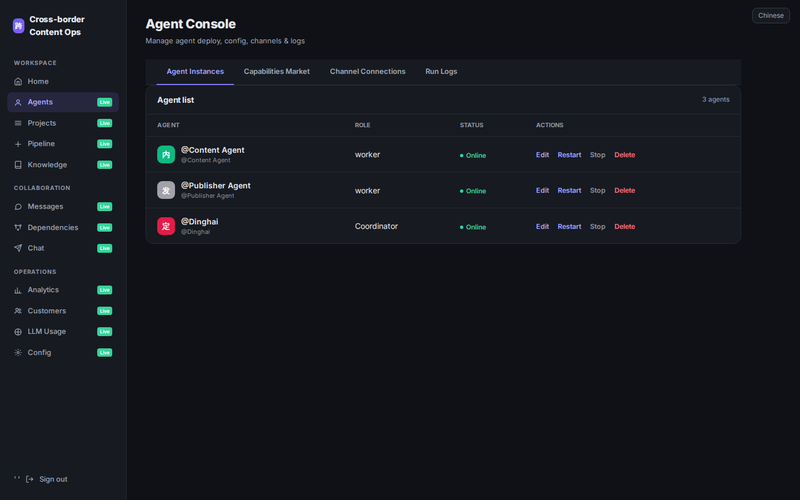
Figure: Agent management console
TL;DR for technical decision-makers: dinghai.vibelingan.com is not another AI writing tool or a social-media scheduler. It is the management & operations layer of Vibe Lingan's cross-border content platform — a single web console where a brief in natural language is decomposed by an orchestrator agent, executed by specialized agents, quality-gated through three review gates, published to seven overseas platforms, and reported back with transparent, usage-based metering. This article walks the platform end-to-end: access model, console architecture, agent roles, the full task lifecycle, and the operational guardrails that matter when you hand brand voice to autonomous agents.
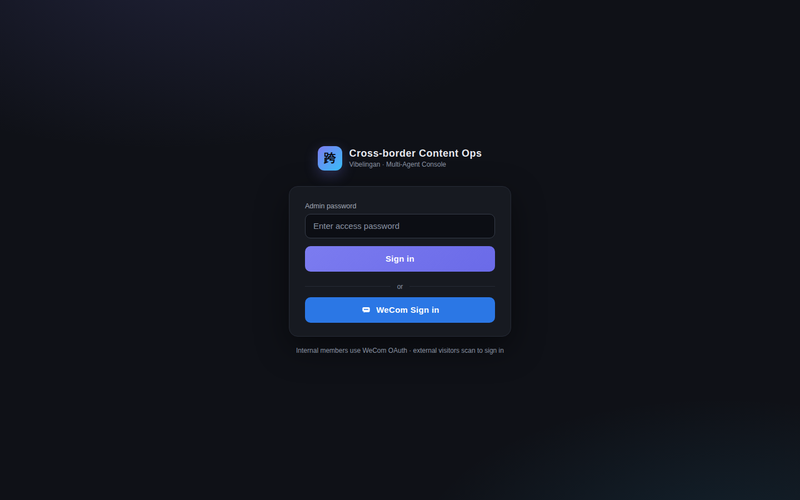
Figure: Operations console login (admin password / corporate IdP OAuth)
1. What the Platform Is (and What It Is Not)
Most "AI marketing" products sit at one of two extremes: they are either generation tools (you prompt, they draft, you still do the rest) or schedulers (you bring finished content, they queue it). Vibe Lingan's console occupies a different slot in the stack: it is an operations console for a managed, multi-agent content supply chain.
Positioning, precisely:
- It is a management plane. You interact with a running operations team — a coordinator agent plus execution agents — not with a blank text box. The unit of work is a business outcome ("run our Q4 product-launch content across English-speaking markets"), not a single artifact.
- It is not a self-serve toy. Access is gated, because the console drives real brand accounts under real compliance constraints. This is an operations platform for teams that have accepted AI into production, not a demo sandbox.
- It is opinionated about workflow. Topic selection → content production → compliance review → multi-platform publishing → performance review is a fixed, observable pipeline. You get leverage precisely because the platform owns the orchestration, not just the text generation.
The console is branded 跨境内容运营台 — Vibelingan · Multi-Agent Console, and that subtitle is the accurate technical description: a console for operating multiple agents.
2. Console Architecture: One Conversation, Three Agent Roles
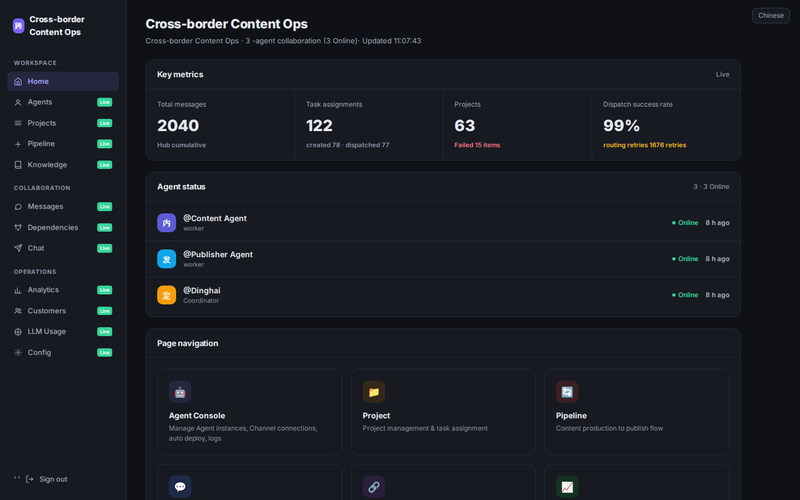
Figure: Operations dashboard — agent & task overview
Functionally, the console is organized around a single operational conversation in which work is dispatched to a small, well-defined agent team. The roles are fixed and deliberately narrow — that narrowness is what makes the system governable.
3.1 Dinghai (定海) — the orchestration hub
Dinghai is the strategy and coordination layer. It is the agent you actually talk to. Its responsibilities:
- Intent intake. Takes a natural-language brief ("launch content for the new air fryer in Poland, focus on busy parents") and turns it into a structured task plan.
- Task decomposition. Splits the plan into subtasks — topic research, drafting, localization, compliance checks, scheduling — and assigns each to the right execution agent.
- Review & gating. Applies the platform's three quality gates (brand tone, compliance, budget) before anything is allowed to publish.
- Reporting. Rolls execution status and results back into the same conversation, so the human sees the whole lifecycle without chasing dashboards.
3.2 Content Factory Agent (内容工厂助手) — production
The production engine. Given a brief from Dinghai, it produces the actual assets: post copy, long-form articles, video scripts, and localized variants across target languages. It is optimized for throughput and consistency of voice, and it operates against the client's knowledge base and brand guidelines rather than free-styling.
3.3 Publishing Agent (发布小助手) — distribution
The distribution layer. It takes approved content and handles:
- Multi-platform publishing across the seven supported overseas platforms: Facebook, Instagram, TikTok, YouTube, LinkedIn, X, and Pinterest.
- Smart scheduling — timing posts per platform and per market rather than blasting everything at once.
- Performance tracking — pulling back engagement data so results feed the next cycle instead of sitting in a separate analytics silo.
The key architectural point: you never orchestrate these agents by hand. You state intent once; Dinghai runs the team. That is the difference between an operations console and a toolbox.
3. The Task Lifecycle: From One Sentence to a Published, Reviewed Campaign
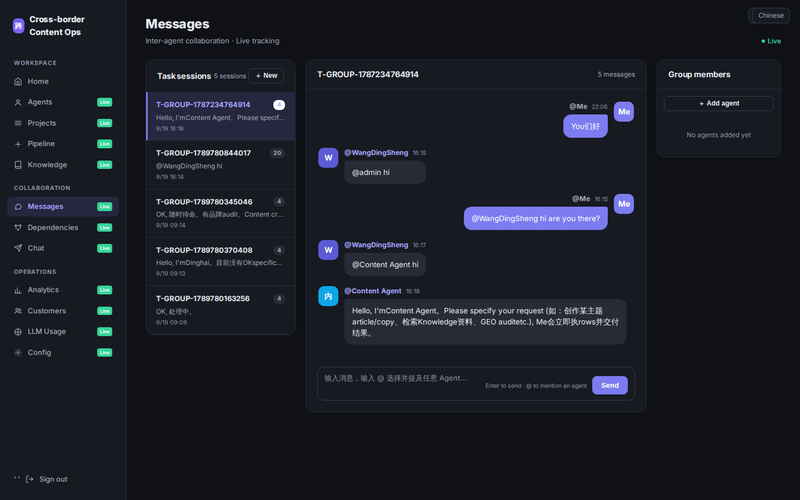
Figure: Message stream — live task timeline
This is the operational heart of the platform — the fixed pipeline every request flows through. Understanding it is what lets a technical buyer predict behavior, cost, and failure modes.
Step 1 — Intent in natural language
You open the console and state the outcome you want in one message. No forms, no per-platform setup. Example: "Plan and publish two weeks of LinkedIn + X content for our European B2B launch, tone: technical but accessible."
Step 2 — Decomposition & planning
Dinghai parses the request, consults the client's knowledge base and brand rules, and returns a structured plan: target platforms, content mix, cadence, and the checkpoints where a human will be asked to confirm. Typical acknowledgment latency is on the order of 15–20 seconds — fast enough to feel like a conversation, not a ticket queue.
Step 3 — Production with process visibility
The Content Factory Agent drafts. Crucially, the console surfaces process cards and artifact cards in real time: you can watch topics being selected, drafts being produced, and assets being assembled as they happen. This is the "watch it run" property — the opposite of a black box that returns a ZIP file an hour later.
Step 4 — Three quality gates
Before anything can publish, content passes three explicit gates, enforced by the platform rather than by goodwill:
| Gate | What it checks | Why it exists |
|---|---|---|
| Brand tone | Voice, terminology, style-guide conformance | Keeps autonomous output on-brand across languages |
| Compliance | Advertising-claim limits, platform policies, regional ad-law red lines | Prevents the classic "AI wrote something we can't say" incident |
| Budget | Scope vs. the engagement's usage envelope | Keeps autonomous operation cost-predictable |
Anything that fails a gate is routed back with the reason, not silently dropped.
Step 5 — Scheduled, multi-platform publishing
Approved content is handed to the Publishing Agent, which schedules and posts to the selected platforms under OAuth authorization. The platform uses official OAuth authorization — you never hand over account passwords. For a security review, this is a hard requirement and the platform meets it.
Step 6 — Performance feedback & loop closure
Results are tracked and rolled back into the same operational thread: what shipped, where, and how it performed. Because intake, execution, and measurement live in one place, the next brief starts from evidence rather than from a blank page.
4. Feature Map: What the Console Actually Exposes
Beyond the pipeline itself, the operations surface covers the full management loop:
- Brief intake & task tracking — every request becomes a trackable task with status, owner (agent), and history.
- Real-time process & artifact cards — live visibility into agent work-in-progress, not just final output.
- Knowledge-base integration — production agents draw on the client's curated knowledge base, so output compounds instead of restarting from zero each campaign.
- Multi-language localization — content is localized per market as part of the pipeline, not as an afterthought.
- Asset management — uploaded brand assets (logos, covers, product imagery) are stored and served from the platform for reuse across posts.
- Usage-based, transparent metering — consumption is visible in the console; there are no hidden seats or surprise tiers. For procurement, this maps to a clean opex line rather than a per-seat SaaS negotiation.
5. Operational Guardrails (the Part Technical Buyers Actually Grill)
When we walk CTOs and heads of digital through the console, the questions are always the same four. Here are the straight answers.
"What stops the agents from publishing something off-brand or non-compliant?"
The three gates in §3, plus the fact that publishing credentials are scoped and revocable. Agents can prepare anything; they can publish only what clears tone, compliance, and budget review.
"What happens when something goes wrong mid-campaign?"
Because the pipeline is explicit and every task is logged, failures are attributable: you can see which gate rejected a draft, or which platform returned an error, and correct course in the same thread. There is no opaque retry storm.
"How do we keep costs predictable with autonomous agents?"
The budget gate plus usage-based metering. You see consumption as it accrues, and the platform will not exceed the engagement envelope without a human sign-off.
"Can it publish to China-domestic platforms?"
Not through this console. The seven supported platforms are overseas networks (Facebook, Instagram, TikTok, YouTube, LinkedIn, X, Pinterest). Domestic Chinese platforms (WeChat Channels, Xiaohongshu, etc.) run through a separate, human-in-the-loop channel — a deliberate boundary, not an oversight.
6. Who This Console Is For
- Heads of digital / growth at brands expanding overseas who need a managed content supply chain, not another tool to operate.
- Technical decision-makers who must answer "is this governable, auditable, and secure enough to attach to our brand accounts?" — the access model, OAuth-only publishing, and three-gate review are designed to survive that review.
- Operations leads who want one place where intent, execution, and measurement meet.
7. The Bottom Line
Vibe Lingan's Multi-Agent Console is best understood as management infrastructure for an AI content team: a gated, auditable control plane where a single sentence of intent is decomposed by an orchestrator, produced and localized by a content agent, gated through tone/compliance/budget review, published to seven overseas platforms under OAuth, and reported back with usage-based metering. If your evaluation criteria for "AI in marketing" are governance, observability, and unit economics rather than raw text generation, this is the layer worth a hard look.
Access is provisioned per engagement. To see the console against your own brand workflow, contact Vibe Lingan for a guided walkthrough.
Product UI screenshots in this article are actual captures of the live console portal (desktop and mobile). Workflow, roles, gates, and platform boundaries are described from the platform's operational specification.